By Bilal Khan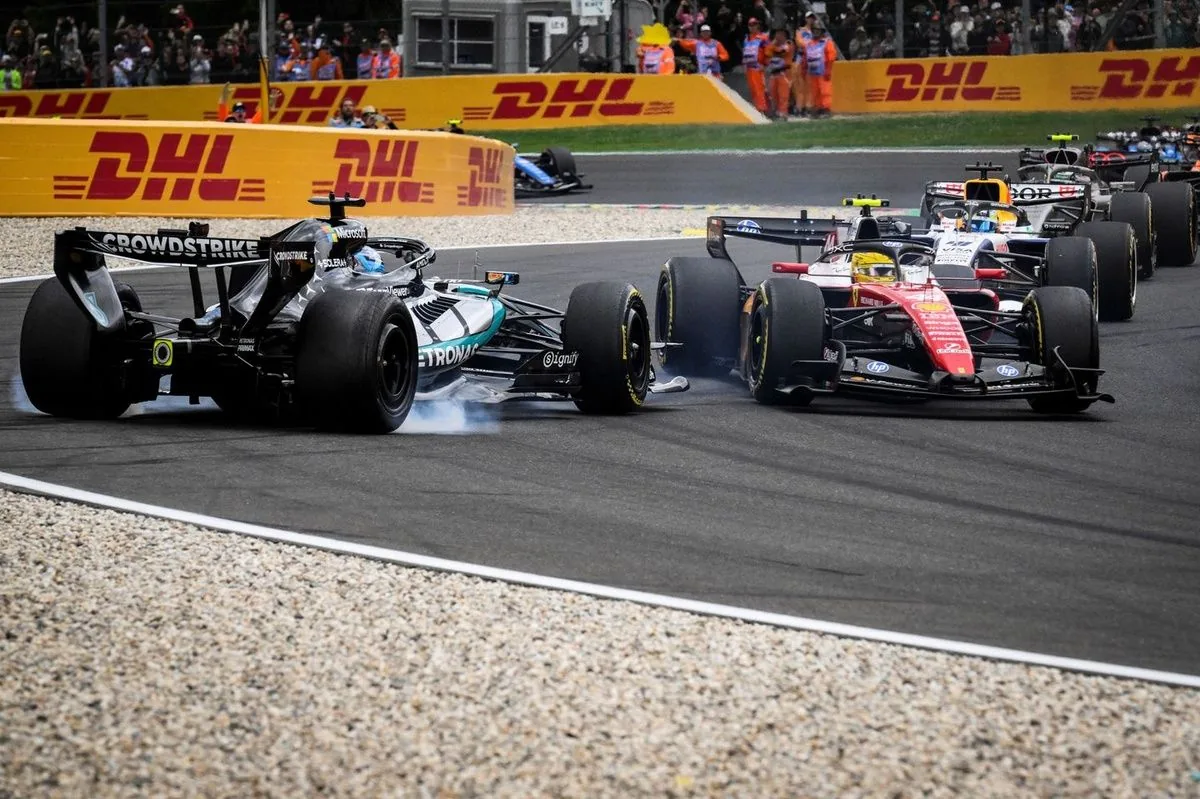
Following his early exit from the Formula 1 Belgian Grand Prix, George Russell’s angry radio message became a significant talking point. The message, which was not broadcast live on the usual international feeds, later emerged through German television coverage, revealing his frustration with a lack of power deployment from his Mercedes car.
Russell was involved in a collision with Lewis Hamilton at Les Combes on the opening lap of the Spa-Francorchamps race. While Hamilton received a penalty from the FIA stewards for his role in the incident, Russell attributed the crash to his car’s lack of deployment, which left him vulnerable on the run up to the corner.
Deployment issues and their impact
Russell’s complaints centered on the absence of battery deployment both on the first lap and throughout the entire weekend, where his top speed was reportedly lower than that of his teammate, Kimi Antonelli. Mercedes team principal Toto Wolff indicated that all Mercedes cars experienced an energy deficit coming out of the opening corner, La Source, with a software error believed to be the cause, preventing the cars from achieving maximum power on the straight.
Telemetry data from both Russell’s and Antonelli’s cars showed problems after exiting La Source. Antonelli’s car reportedly stopped accelerating around the 300km/h mark as they approached Eau Rouge, allowing Max Verstappen to pass. Russell’s pace also showed signs of decline, being 10km/h slower than his teammate at one point, although he later gained speed entering Eau Rouge at 310km/h.
However, Russell encountered greater difficulties after exiting Raidillon. Despite being at full throttle and following his engineer’s instruction to use the boost button, his speed was capped at 308km/h for several seconds before gradually increasing to 315km/h at the entry to Les Combes. Antonelli’s car, in contrast, appeared to operate in two speed stages on the Kemmel Straight, reaching 313km/h and then 318km/h, which enabled him to draft past Verstappen, who was experiencing low power.
Oscar Piastri of McLaren, despite a slow exit from La Source, reportedly had good deployment up to Les Combes, reaching 337km/h before derating. The telemetry data for Ferrari on the opening lap was not deemed reliable enough to accurately assess the performance of Lewis Hamilton and Charles Leclerc against Mercedes, though both appeared to have good deployment.
The decision to mute the broadcast
The reason Russell’s radio message was not included in the official broadcast, appearing only on the German feed, sparked intrigue. Speculation arose regarding potential censorship of deployment criticisms or even the authenticity of the message. However, it has been confirmed that the radio message was indeed real.
The decision to mute the message on the international feed and F1 TV’s radio channels was due to the strong language used by Russell. A system, reportedly implemented by former managing director of motorsport Ross Brawn, filters out extremely angry messages and bad language from broadcast. A team of eight editors and producers at F1’s Biggin Hill broadcast center reviews all radio messages, categorizing them for broadcast as fully transcribed with audio, audio-only, or text-only.
This process can lead to a delay of up to 15 seconds between live images and radio messages. While some on-the-edge messages may be broadcast with bleeps to censor swear words, messages deemed too emotional or expletive-laden are sometimes not broadcast at all to protect drivers. F1’s director of broadcast and media, Dean Locke, previously stated that there is a responsibility to consider if drivers might regret their words, leading to muting or bleeping such communications. Russell’s language after his crash was reportedly deemed too strong for broadcast, even with bleeps.
Some television channels, however, are understood to have direct access to unfiltered radio messages, which explains how the German channels were able to broadcast Russell’s in-car rant. The incident highlights the challenges of monitoring numerous driver and engineer communications to filter out unsuitable content.
Read Also
Source: the-race.com