By newsroom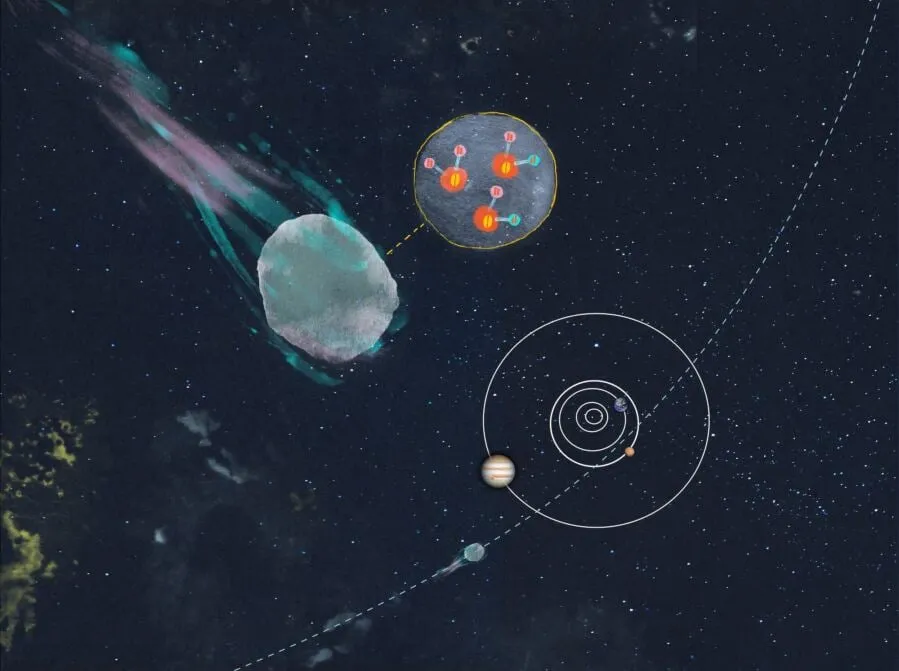
The interstellar comet 3I/ATLAS carries an unprecedented level of deuterium-rich water, suggesting it formed in a much colder environment than our solar system. The comet was discovered in July 2025 and is only the third interstellar object identified passing through our solar system.
Key findings:
- The water in 3I/ATLAS has roughly 30 to 40 times more deuterium than Earth’s oceans.
- The deuterium-to-hydrogen ratio in its water is at least 30 times higher than any comet measured in our solar system.
- The estimated age of the comet is between 3 billion and 11 billion years.
- The ALMA telescope, with its array of 66 antennas located at an altitude of 5,000 meters, detected the spectral fingerprint of the deuterated water.
Luis Salazar Manzano from the University of Michigan stated, “Our new observations show that the conditions that led to the formation of our solar system are much different from how planetary systems evolved in different parts of our galaxy.” This finding underscores a divergence in chemical history between 3I/ATLAS and comets from our own solar system.
Teresa Paneque-Carreño added, “This is proof that whatever the conditions were that led to the creation of our solar system are not ubiquitous throughout space.” The implications for understanding galactic history are significant.
Future research may provide more clarity on these differences. However, the unique characteristics of 3I/ATLAS already challenge existing models of planetary formation.