









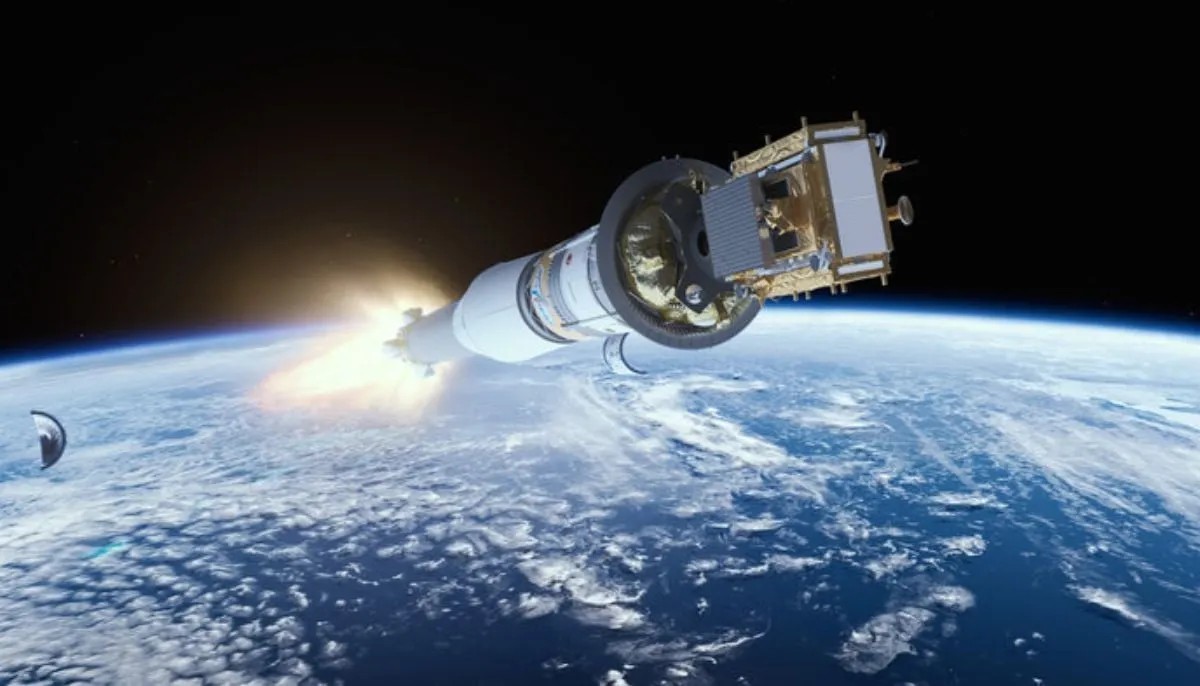
In a significant development for space weather observation, China and Europe are preparing to launch a joint space mission. The satellite, named Smile, is scheduled for launch on April 6, 2026, and aims to study the role of Earth’s magnetic field in relation to solar activity.
Smile is equipped with four scientific instruments, including a soft X-ray imager, and will orbit approximately 121,000 kilometers above the North Pole. This mission is expected to enhance the ability to forecast geomagnetic storms more quickly and accurately, providing crucial data for understanding solar eruptions and their effects on Earth.
Colin Forsyth, a researcher involved in the project, stated, “We will be able to see how our magnetic bubble changes its shape, whether it does this smoothly or in steps, and how it gets squeezed down as eruptions from the Sun pass Earth.” The satellite weighs about 2.3 tonnes and will spend 45 hours assessing the northern lights aurora.
Meanwhile, the Pakistan Meteorological Department has predicted dry weather across most districts of Sindh this weekend. Residents can expect 24 hours of dry conditions, which may provide a brief respite from the typically variable weather of the region.
In contrast, the weather in the UK will be influenced by Storm Dave, which is expected to dominate the weekend’s conditions. Patchy rain is forecasted to move northwards, becoming heavier over Northern Ireland and Scotland, while Monday is anticipated to be mostly dry due to high pressure centered to the southeast.
This joint mission between China and Europe dates back to 2016 when the Chinese Academy of Sciences and the European Space Agency agreed to collaborate on this important project. The Smile satellite represents a significant step forward in our understanding of space weather and its impact on Earth.
As the launch date approaches, both the scientific community and the public are keenly awaiting the results of this mission, which promises to provide valuable insights into the dynamics of space weather.
Details remain unconfirmed regarding the exact launch time and any potential delays that may arise. However, the collaboration between these two regions highlights the growing importance of international partnerships in scientific research.