









Upcoming Blood Moon: Total Lunar Eclipse on March 3, 2026
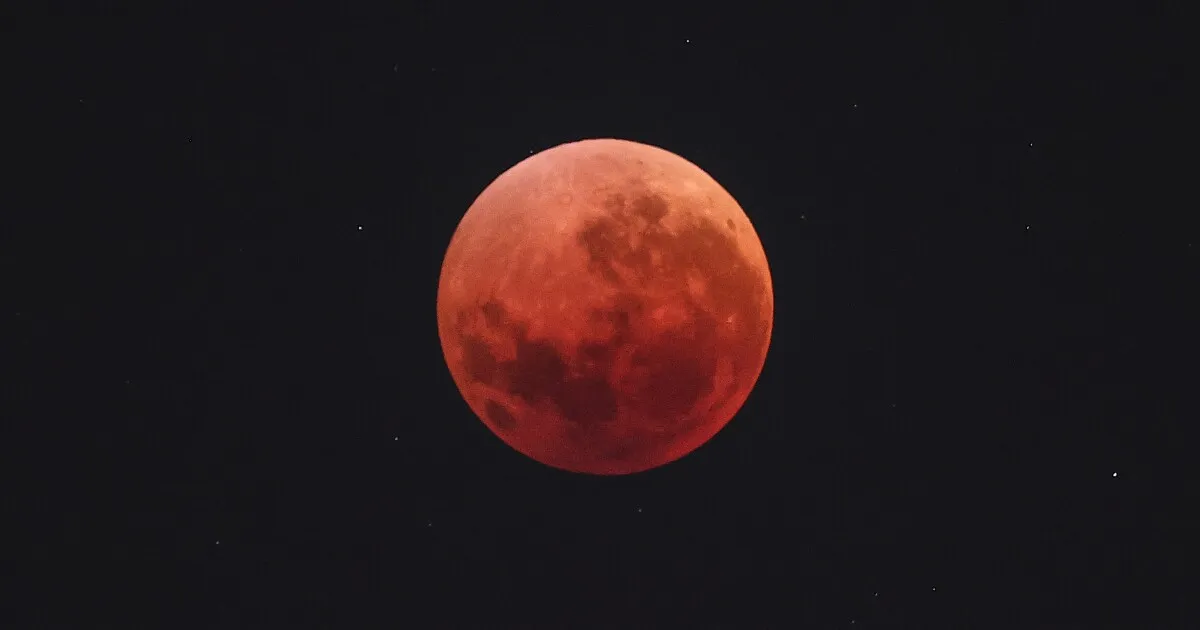
A total lunar eclipse, also referred to as a blood moon, is set to occur on March 3, 2026, with a duration of 58 minutes. This celestial phenomenon will be visible across North America, parts of South America, East Asia, Australia, New Zealand, and the Pacific, providing a spectacular sight for millions of observers.
During a total lunar eclipse, the Earth is positioned directly between the sun and the moon, causing the moon to take on a reddish hue. This occurs as sunlight is filtered through the Earth’s atmosphere, casting a shadow that envelops the full moon. As one expert noted, “A Blood Moon is defined by its distinctive red glow, occurring during a total lunar eclipse when the Earth’s shadow completely covers the full moon, filtering sunlight through our atmosphere.”
The eclipse will be visible in various time zones across the United States, including Eastern, Central, Mountain, Pacific, Alaska, and Hawaii. In the Eastern time zone, the total lunar eclipse will be visible from 6:04 to 7:02 a.m. EST, while in Central time, it will occur from 5:04 to 6:02 a.m. CST. Observers in Mountain time will see it from 4:04 to 5:02 a.m. MST, and those in Pacific time from 3:04 to 4:02 a.m. PST. Alaska and Hawaii will have their respective viewing times from 2:04 to 3:02 a.m. AKST and 1:04 to 2:02 a.m. HST.
States such as Hawaii, Alaska, Washington, Oregon, Arizona, Colorado, and California are expected to have prime viewing conditions, making them ideal locations for enthusiasts and casual observers alike. The total lunar eclipse is a rare event that has captivated humanity for centuries, often inspiring awe and wonder.
Historically, total lunar eclipses have been significant in various cultures, often associated with omens or significant events. The blood moon has been a subject of fascination and study, leading to various interpretations and beliefs throughout history.
As the date approaches, astronomers and enthusiasts alike are preparing for this remarkable event, which promises to be a highlight in the astronomical calendar. Details remain unconfirmed regarding the exact visibility conditions in specific regions, but the anticipation continues to build.
With the next blood moon on the horizon, observers are encouraged to prepare their viewing equipment and find suitable locations to witness this extraordinary celestial event. The total lunar eclipse on March 3, 2026, is not just a moment to observe the beauty of the universe but also an opportunity to connect with the rich history of astronomical phenomena.