









Introduction
The magnetic north pole is a vital geographical landmark that affects navigation and understanding of Earth’s magnetic field. Its movement and fluctuations are increasingly relevant in today’s world, particularly with advancements in technology and changing navigation systems. As the magnetic north pole continues to shift, it raises questions concerning navigation, climate change, and geological science.
Current Position of the Magnetic North Pole
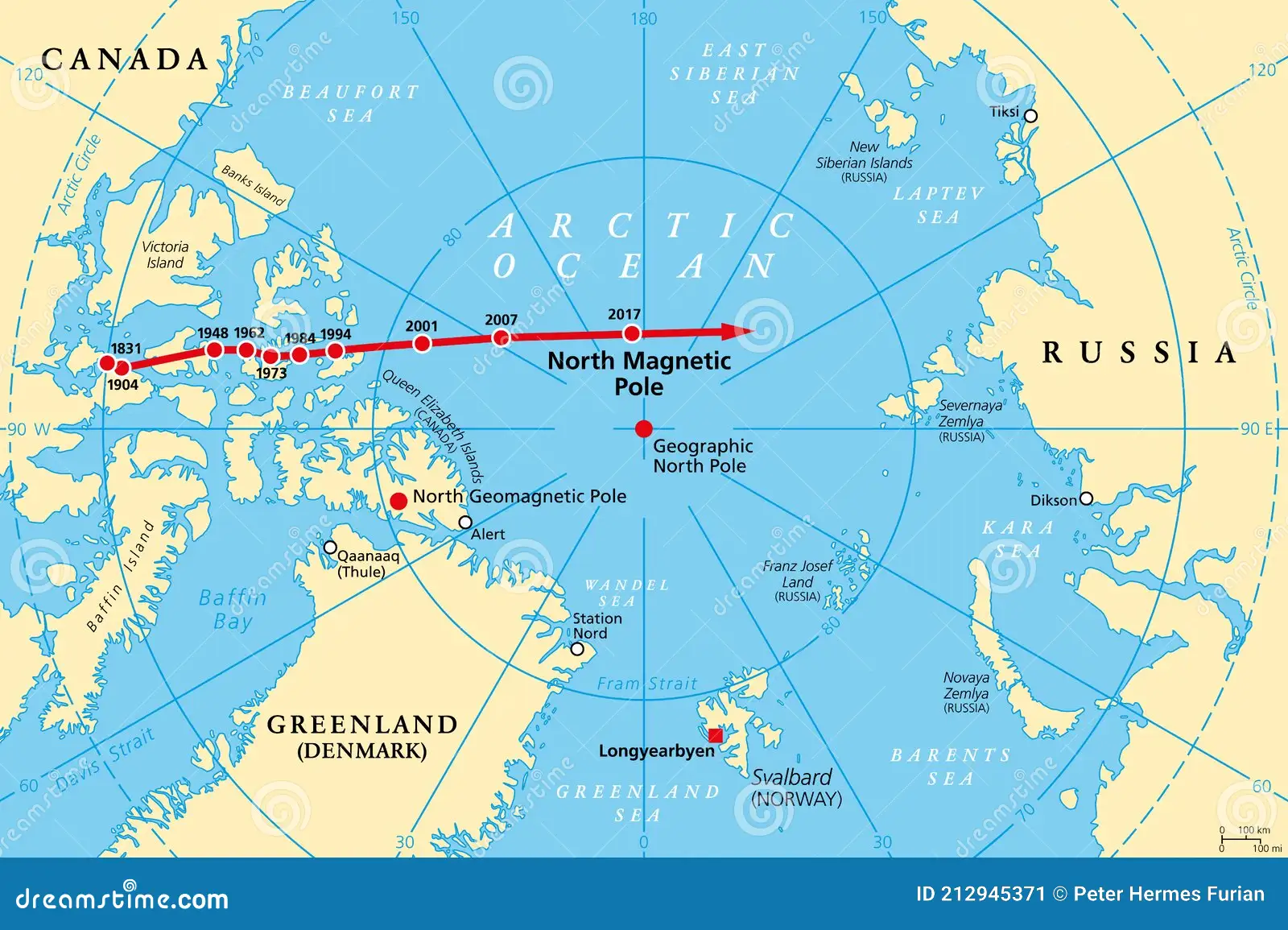
As of 2023, the magnetic north pole is located off the northern coast of Canada in the Arctic region. Recent studies indicate that it has been moving at an accelerated rate, currently heading towards Russia at about 55 km per year. This rapid movement is attributed to the complex interactions of molten iron within Earth’s outer core, as well as changes in Earth’s magnetic field.
Impact on Navigation Technologies
The magnetic north pole plays a crucial role in navigation. Traditional compass-based navigation relies on the magnetic north pole being in a relatively stable position. However, with its current shifting, global positioning systems and digital navigation tools have had to adapt. The World Magnetic Model (WMM), which is regularly updated to reflect changes, assists in ensuring accuracy for military and civilian navigation alike. Failure to account for these shifts can lead to navigational errors, with significant implications for aviation and maritime operations.
Environmental and Geological Significance
Scientists are studying the movement of the magnetic north pole closely as it may provide insights into geological phenomena and the dynamics of Earth’s core. The shifting of the magnetic poles has historically coincided with significant geological events, including mass extinctions and climate shifts. By understanding these changes, researchers hope to predict future patterns that could impact climate change and environmental conditions globally.
Conclusion
The ongoing changes of the magnetic north pole serve as a reminder of the dynamic nature of our planet. For those relying on navigation systems, both current and future adjustments to magnetic models are essential for maintaining accuracy. Furthermore, the implications of these shifts can be profound as they may help scientists to learn more about Earth’s geological processes and their potential impact on climate. As we continue to monitor the magnetic north pole, it will remain a topic of significant scientific investigation and public interest.